
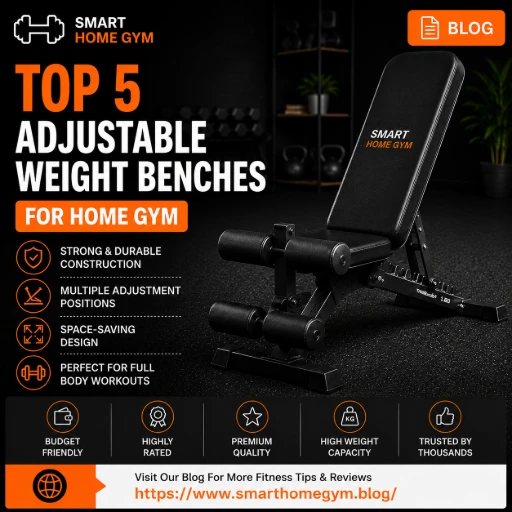
An adjustable weight bench can make a home gym considerably more versatile. Instead of using a bench only for flat pressing, an adjustable model can provide incline and, on some models, decline positions for exercises such as presses, rows, seated movements, and core work.
But adjustability alone does not make a bench a good choice.
When comparing adjustable benches, it is worth looking at the adjustment range, weight capacity, pad dimensions, stability, storage requirements, seat adjustment, and the amount of space available in your workout area.
This guide explains the main features to consider and compares five adjustable benches with different designs and specifications.
Affiliate disclosure: Some links on this page may be affiliate links. If you make a qualifying purchase through an affiliate link, Smart Home Gym may receive a commission at no additional cost to you. See our Affiliate Disclosure page for more information.
Why Use an Adjustable Weight Bench?
A flat bench provides a stable horizontal surface for exercises such as flat dumbbell presses and supported rows. An adjustable bench adds different angles, allowing the same piece of equipment to be used for a wider range of movements.
Depending on the model, an adjustable bench can be used for:
- Flat dumbbell presses
- Incline presses
- Decline exercises
- Seated shoulder presses
- Incline curls
- Supported rows
- Step-ups and split squats
- Core exercises
- Other dumbbell and bodyweight movements
For a home gym, this versatility can be useful because one bench can support several training positions without requiring separate pieces of equipment.
However, adjustable benches also contain moving parts and adjustment mechanisms. A simple flat bench may therefore be preferable for someone who does not need multiple angles.
Adjustable vs. Flat Weight Bench
The first decision is whether you actually need an adjustable bench.
| Feature | Adjustable Bench | Flat Bench |
|---|---|---|
| Positions | Flat plus incline and/or decline depending on model | Fixed flat position |
| Exercise variety | Higher | More limited |
| Adjustment mechanism | Yes | No |
| Storage | Varies by model | Usually simpler |
| Setup | Angle needs to be selected | Consistent setup |
| Complexity | Higher | Lower |
| Suitable for | Users wanting multiple training angles | Users focused mainly on flat exercises |
An adjustable bench makes more sense when you want to perform several types of pressing and seated exercises.
A flat bench can make sense when simplicity, a consistent setup, or a lower equipment cost is more important.
What to Look for in an Adjustable Weight Bench
Not every specification has the same importance. Before comparing brands, consider these factors.
1. Weight Capacity
Check the manufacturer's definition of the stated capacity.
Some manufacturers specify a combined user weight plus lifted load, while others may present capacity information differently.
For example, BowFlex lists a maximum user-plus-load weight of 600 lb (272 kg) for the 5.1S.
PowerBlock lists a 1,000 lb (454 kg) capacity for its PowerBench 2.0.
Do not compare capacity numbers without first checking what the manufacturer means by the rating.
A practical calculation is:
Your body weight + the weight you are lifting = required supported load
Always stay within the manufacturer's stated limit.
2. Adjustment Positions
Look at the actual angles rather than simply counting the number of positions.
Useful positions can include:
- Flat
- Low incline
- Moderate incline
- Steeper incline
- Upright
- Decline
A bench with many positions is not automatically more useful if the positions do not suit the exercises you perform.
For example, the PowerBench 2.0 has five back-pad positions—flat, 30°, 45°, 60°, and 80°—plus two seat positions.
The BowFlex 5.1S provides six adjustment angles, including flat, incline positions, upright, and a -20° decline position.
3. Seat Adjustment
The seat is sometimes overlooked when comparing benches.
A separately adjustable seat can help keep your body positioned more comfortably when the backrest is inclined.
Check:
- Number of seat positions
- Seat angle
- Seat width
- Gap between seat and back pad
- Whether the seat moves independently
The PowerBench 2.0, for example, provides a flat seat position and a 20° incline.
4. Pad Dimensions and Gap
The size and shape of the padding can affect comfort and positioning.
Look for manufacturer information about:
- Back-pad length
- Seat dimensions
- Pad thickness
- Pad width
- Seat-to-back gap
A very large gap between the two pads may be noticeable during certain exercises, while an overly narrow pad may provide less support.
Rather than relying only on a product's marketing description, check the actual dimensions whenever they are available.
5. Stability
A bench should remain stable on the floor during normal use.
When comparing models, look for information about:
- Base width
- Frame construction
- Foot design
- Leveling feet
- Overall bench weight
- Manufacturer-rated capacity
For example, PowerBlock states that the PowerBench 2.0 includes leveling mounts intended to help stabilize the bench on uneven surfaces.
However, specifications cannot tell you everything about how a particular bench will feel during use. If you cannot test a bench yourself, checking the manufacturer's construction information and reliable owner feedback can provide additional context.
6. Bench Height
Bench height matters because it affects how easily your feet can reach the floor and how you position yourself during pressing exercises.
Before buying, check the manufacturer's stated height and compare it with your own body proportions.
This is particularly important if the bench will be used with a power rack or other equipment.
7. Footprint and Storage
Measure the space where you intend to use the bench—not just the storage area.
You need enough room to:
- Place the bench
- Move around it
- Perform exercises safely
- Adjust the backrest
- Access dumbbells
- Store the bench when it is not being used
For small rooms, a stowable or foldable design can be particularly useful.
The BowFlex 5.1S, for example, is designed to stand vertically for storage and has a listed stowed footprint of approximately 60.6 × 71.3 cm, with a height of 132.9 cm.
Five Adjustable Benches to Compare
The following models use different approaches to adjustable bench design. They are presented for comparison rather than as a universal ranking.
1. BowFlex 5.1S Stowable Bench
The BowFlex 5.1S is designed for users who want an adjustable bench that can also be stored vertically.
According to BowFlex, it provides six adjustment angles: flat, 30°, 45°, 60°, 90°, and -20° decline. The manufacturer lists a 600 lb (272 kg) maximum user-plus-load capacity.
Key specifications
- Six adjustment angles
- Flat, incline, upright, and decline positions
- Seat adjustment
- 600 lb / 272 kg maximum user-plus-load weight
- Approx. 60 lb / 27.2 kg bench weight
- Transport wheels
- Vertical storage design
- Stowed dimensions: approximately 60.6 × 71.3 × 132.9 cm
Why it may suit some users
Its main distinguishing feature is the combination of adjustability and vertical storage.
That can be useful when the same room serves multiple purposes and the bench needs to be moved out of the way after training.
Things to consider
- Its storage design matters most if you actually need to reclaim floor space.
- The 600 lb rating includes user weight plus load, according to BowFlex.
- Buyers should verify current price, warranty, and availability before purchasing.
Consider it if: Storage and multiple training angles are important factors in your home gym.
2. PowerBench 2.0
The PowerBench 2.0 from PowerBlock is designed around a heavier-duty construction approach.
PowerBlock lists a 1,000 lb / 454 kg capacity, 75 × 75 mm steel tubing, and a 3-inch heavy-duty pad.
Key specifications
- Five back-pad positions
- Flat, 30°, 45°, 60°, and 80° back positions
- Flat and 20° seat positions
- 1,000 lb / 454 kg stated capacity
- 75 × 75 mm steel tubing
- 12-gauge steel tubing
- Approx. 74 lb bench weight without attachments
- Roller wheels
- Adjustable leveling mounts
- Optional Ab, Dip, and Pull-Up attachments
Why it may suit some users
The combination of a high stated capacity, heavy-duty frame construction, and multiple adjustment positions makes it relevant for users who prioritize a more substantial bench.
The adjustment system also does not use a selector pin; PowerBlock describes a support-rod adjustment system.
Things to consider
- Its heavier construction may be unnecessary for casual users.
- Optional attachments add cost and are not required for normal bench use.
- Buyers should check the current configuration and price before purchasing.
Consider it if: High load capacity and heavy-duty construction are priorities.
3. Keppi Bench1000
The Keppi Bench1000 is focused heavily on adjustability.
Keppi currently lists 12 backrest positions and three seat adjustments, providing up to 36 angle combinations. The manufacturer also lists a 1,200 lb capacity for the current Bench1000 Pro specification.
Key specifications
- 12 backrest positions
- Three seat adjustments
- Up to 36 angle combinations
- Flat, incline, and decline positions
- Commercial-grade steel frame
- 70 × 50 mm frame tubing
- 1,200 lb stated capacity for the current Bench1000 Pro specification
Why it may suit some users
The large number of adjustment combinations gives users more control over their setup.
This can be useful if you regularly change angles for different exercises.
Things to consider
- More adjustment positions do not necessarily mean you need all of them.
- Verify that the exact Bench1000 model you are purchasing has the specifications listed above.
- Check the bench footprint before buying if your workout area is small.
Consider it if: A wide range of adjustment options is more important to you than having the simplest possible bench.
4. Fitness Reality 2000 Super Max XL
The Fitness Reality 2000 Super Max XL is another adjustable bench designed for home strength training.
The model is commonly positioned around flat, incline, and decline training and includes a leg hold-down feature for certain decline exercises.
Before purchasing, verify the current manufacturer's specifications because product configurations and listings can change.
Potential advantages
- Flat, incline, and decline functionality
- Suitable for a variety of dumbbell exercises
- Decline training support
- Designed for home strength training
- Can serve as a general-purpose adjustable bench
Things to consider
- Measure the footprint before buying.
- Verify the current weight-capacity specification.
- Check exactly what accessories are included with the version being sold.
- Compare the current price with competing benches offering similar specifications.
Consider it if: You want a general-purpose adjustable bench and its current specifications fit your training requirements.
5. FLYBIRD Adjustable Weight Bench
FLYBIRD produces several adjustable bench models, so specifications can vary between versions.
Many models are designed around compact home-gym use, with adjustable positions and foldable or space-conscious designs.
Potential advantages
- Often designed for smaller workout spaces
- Multiple adjustment positions on many models
- Generally aimed at home users
- Can provide incline and decline functionality depending on model
Things to consider
Do not rely on the brand name alone.
Before purchasing a FLYBIRD bench, verify:
- Exact model number
- Maximum user-plus-load capacity
- Number of positions
- Dimensions
- Folded dimensions
- Warranty
- Included accessories
Consider it if: You need a compact home-gym bench and the exact model's specifications meet your requirements.
Adjustable Bench Comparison
| Bench | Main design focus | Adjustment | Capacity / specification | Storage consideration |
|---|---|---|---|---|
| BowFlex 5.1S | Space-conscious adjustable bench | 6 angles | 600 lb / 272 kg user + load | Vertical stowage |
| PowerBench 2.0 | Heavy-duty training | 5 back + 2 seat positions | 1,000 lb / 454 kg | Roller wheels |
| Keppi Bench1000 | Extensive adjustability | 12 back + 3 seat positions | Up to 1,200 lb on current Pro specification | Check footprint |
| Fitness Reality 2000 Super Max XL | General home strength use | Flat/incline/decline | Verify current model | Check footprint |
| FLYBIRD adjustable models | Compact home use | Varies by model | Verify exact model | Foldable designs vary |
Note: Specifications can change between models, revisions, and retailers. Always verify the exact product listing before purchasing.
Which Type of Adjustable Bench Do You Need?
Instead of asking which bench is “the best,” start by identifying what your home gym actually needs.
For a Small or Multi-Purpose Room
Prioritize:
- Compact footprint
- Vertical or foldable storage
- Transport wheels
- Easy setup
- Appropriate weight capacity
A stowable model such as the BowFlex 5.1S may be worth considering if storage is a major concern.
For Heavy Strength Training
Prioritize:
- High rated capacity
- Strong frame construction
- Stable base
- Appropriate pad dimensions
- Reliable adjustment mechanism
The PowerBench 2.0, for example, is built around a heavy-duty frame and a 1,000 lb stated capacity.
For Maximum Adjustment Flexibility
Look for:
- Multiple backrest positions
- Adjustable seat
- Flat position
- Useful incline angles
- Decline capability if you actually need it
A high number of adjustment positions is useful only when those positions match your training needs.
For Beginners
A beginner does not necessarily need the most expensive or highest-capacity bench.
Instead, focus on:
- Stability
- Comfortable padding
- A true flat position
- Useful incline positions
- Appropriate capacity
- Easy adjustment
- A footprint that fits your room
Avoid paying extra for features you are unlikely to use.
Do You Need a Decline Bench?
Not necessarily.
A decline-capable bench gives you additional exercise options, but it also adds another adjustment requirement and may require a leg hold-down or other support depending on the exercise.
If your main exercises are flat presses, incline presses, rows, and seated shoulder work, you may not need decline functionality.
Choose it because you will use it—not simply because it appears on the specification sheet.
Common Adjustable Bench Buying Mistakes
Choosing Based Only on Weight Capacity
A huge capacity rating is not automatically useful if the bench is uncomfortable, too large for your room, or difficult to adjust.
Ignoring the Bench Footprint
Measure your workout area before purchasing.
Remember that you need space around the bench, not just enough floor area for the bench itself.
Counting Adjustment Positions Instead of Checking the Angles
A bench with 12 positions is not necessarily more useful than one with six.
Check the actual angles.
Forgetting the Seat Adjustment
When the backrest is inclined, the seat position can affect comfort and body positioning.
Assuming Every Model From a Brand Has the Same Specifications
Brands often sell multiple versions of a similar bench.
Always check the exact model.
Choosing a Bench That Is Too Light for Your Intended Training
A compact bench can be convenient, but if your training involves heavier loads, make sure its rated capacity and construction are appropriate.
How to Measure Your Home Gym Before Buying
Before ordering an adjustable bench, measure three areas.
1. Operating Space
Measure the floor area where you will perform your exercises.
2. Storage Space
If you plan to fold or store the bench, measure the actual storage location.
3. Access Space
Make sure the bench can physically pass through doors, around furniture, and into the intended room.
This is particularly important for heavier benches.
For example, BowFlex lists the 5.1S at approximately 27.2 kg and provides separate assembled and stowed dimensions.
Adjustable Bench Safety Checklist
Before using an adjustable bench:
- Place it on a firm, level surface.
- Make sure the adjustment mechanism is fully engaged.
- Check that the seat and backrest are securely positioned.
- Stay within the manufacturer's stated capacity.
- Inspect the frame, padding, adjustment points, and hardware periodically.
- Follow the manufacturer's instructions for setup and maintenance.
- Leave adequate space around the bench for safe movement.
BowFlex's user documentation specifically instructs users to operate the bench on a hard, level surface and inspect the equipment for damage before use.
Frequently Asked Questions
What is an adjustable weight bench?
An adjustable weight bench is a workout bench with a movable backrest, and sometimes an adjustable seat, that allows different training angles.
Is an adjustable bench better than a flat bench?
It depends on your training. Adjustable benches provide more exercise positions, while flat benches offer a simpler fixed setup.
What angles should an adjustable bench have?
Useful positions commonly include flat, moderate incline, steeper incline, and, on FID models, decline. The most useful angles depend on the exercises you perform.
How much weight capacity should a bench have?
Your body weight and the load you lift both matter. Check whether the manufacturer's rating refers to combined user-plus-load weight and stay within that limit.
Is a 1,000 lb weight bench necessary?
Not for everyone. A very high capacity may be useful for heavy strength training, but casual users may not need that much capacity.
Should I buy a foldable adjustable bench?
A foldable or stowable bench can be useful when floor space is limited. If you have a dedicated gym room, storage convenience may be less important.
Are more adjustment positions always better?
No. What matters is whether the available angles are useful for your training.
Can an adjustable bench replace a gym machine?
An adjustable bench can support many dumbbell and bodyweight exercises, but it does not replace every type of resistance machine or rack.
Final Takeaway
An adjustable weight bench can be one of the most versatile pieces of equipment in a home gym, but the right choice depends on more than the number of adjustment positions or the maximum weight rating.
Start with your training requirements and available space.
Then compare:
- Weight capacity
- Backrest angles
- Seat adjustment
- Pad dimensions
- Stability
- Bench height
- Footprint
- Storage
- Adjustment mechanism
- Warranty and manufacturer support
If space is your biggest limitation, prioritize storage and footprint. If you train with heavier loads, pay closer attention to capacity and frame construction. If you want maximum exercise variety, look for useful incline and decline positions.
Most importantly, compare the exact model you intend to buy rather than relying on a brand name or a generic product description.
Product specifications, prices, availability, and warranties can change, so verify current information with the manufacturer or retailer before purchasing.
Sources
- BowFlex — 5.1S Stowable Bench specifications and product information
- PowerBlock — PowerBench 2.0 specifications and features
- Keppi Fitness — Bench1000 specifications
- BowFlex — 5.1S user and safety documentation
Last reviewed: October 2026