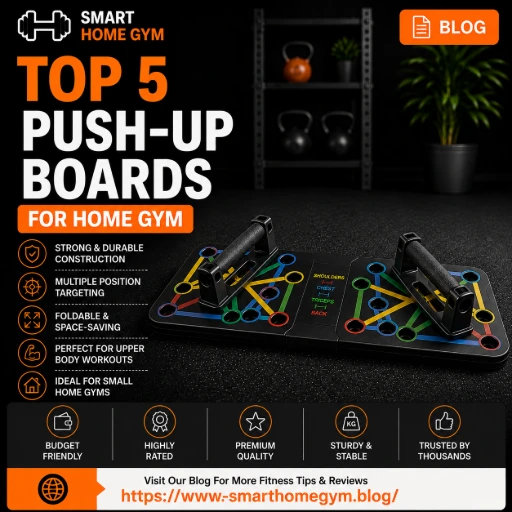
A push-up board is a small piece of equipment designed to give your hands defined positions during push-ups. Instead of placing your hands on the floor and changing their position by guesswork, you can use the board's slots and handles to experiment with different grips and hand widths.
For a small home gym, that can be useful because a push-up board takes considerably less storage space than larger strength-training equipment. However, not every board offers the same construction, stability, handle design, or accessories.
This guide explains what a push-up board actually does, what features are worth paying attention to, how different board designs compare, and when a simple pair of push-up handles may be a better choice.
Affiliate disclosure: Some links on this page may be affiliate links. If you make a qualifying purchase through an affiliate link, Smart Home Gym may receive a commission at no additional cost to you. See our Affiliate Disclosure page for more information.
What Is a Push-Up Board?
A push-up board is a platform with multiple slots or positions for removable handles.
The positions are usually organized by color or markings. Depending on the design, moving the handles changes the width and orientation of your hands.
The purpose is not to make a normal push-up magically more effective. Instead, the board gives you a structured way to vary hand placement and use elevated handles.
This can be useful for people who:
- Want more variety than standard floor push-ups
- Prefer gripping handles instead of placing their palms directly on the floor
- Have limited workout space
- Want equipment that can be stored easily
- Are building a home gym gradually
A push-up board is therefore better viewed as a training accessory, rather than a replacement for a complete strength-training setup.
Do You Actually Need a Push-Up Board?
No.
You can perform standard push-ups without any equipment.
A traditional push-up already trains multiple muscles, including the chest, triceps, shoulders and core musculature. Different push-up variations can change the demands placed on different parts of the upper body.
The main reason to buy a push-up board is convenience and structure.
For example, a board can make it easier to:
- Keep your hand positions consistent
- Try different grip widths
- Raise your hands using handles
- Organize several push-up variations
- Store your equipment after training
If you are happy doing regular push-ups on the floor, buying a board is optional.
Push-Up Board vs. Regular Push-Ups
| Feature | Regular Push-Ups | Push-Up Board |
|---|---|---|
| Equipment required | None | Board and handles |
| Cost | Free | Additional purchase |
| Hand-position guidance | No | Yes |
| Grip variation | Manual | Marked positions |
| Storage | None | Requires small storage space |
| Portability | Excellent | Usually good |
| Wrist position | Hands on floor | Handles can provide a different grip |
| Workout variety | Depends on technique | Easier to organize |
| Best for | Minimalist training | Structured home workouts |
The important point is that the board adds organization and equipment, not a completely different exercise.
What Should You Look for in a Push-Up Board?
The number printed on the package—such as 15-in-1, 20-in-1 or 25-in-1—should not be your only buying criterion.
A board with fewer positions can be more useful than one with many positions if it has a stable base and secure handles.
1. Handle Security
The handles should fit firmly into the board's slots.
Before using a board, check that:
- The handles are fully inserted
- They do not wobble excessively
- The locking mechanism works correctly
- There is no visible cracking or damage
This is particularly important because your bodyweight is transferred through your hands and handles during each repetition.
2. Base Stability
A push-up board is only useful if it stays where you put it.
Look for features such as:
- Non-slip feet
- Rubberized contact points
- A reasonably wide base
- Rigid construction
- Secure connections between the board and handles
Use the board on a firm, level surface rather than a slippery floor.
3. Handle Design
Handle shape can affect how comfortable the equipment feels during a workout.
Consider:
- Grip diameter
- Grip texture
- Handle length
- Whether the handle is padded or molded
- Whether the grip becomes uncomfortable during higher repetitions
If you already experience discomfort during floor push-ups, don't assume that a push-up board will automatically solve it. Different handle designs feel different, and technique still matters.
4. Number of Positions
More positions can provide more options, but the number alone doesn't tell you how useful the board is.
Instead, look at:
- How the positions are arranged
- Whether they support the types of push-ups you actually want to perform
- Whether the handles can be moved easily
- Whether the positions are clearly marked
A simple board with useful positions can be preferable to a complicated board with dozens of rarely used configurations.
5. Board Construction
Check the material and construction of the main platform.
Many inexpensive boards use molded plastic construction. That isn't automatically a problem, but you should look for a rigid platform without obvious flexing, cracks, or poorly finished connection points.
If a manufacturer publishes a specific load or weight rating, check the current product documentation rather than relying on an old article or marketplace listing.
6. Foldability and Storage
If your home gym is in a bedroom, apartment, office or shared room, storage can be just as important as exercise features.
A foldable board can be useful because you can:
- Take it out when needed
- Complete your workout
- Fold the equipment
- Store it in a closet, cabinet or other small space
Measure the folded dimensions if storage space is limited.
7. Included Accessories
Some push-up systems include more than a board.
Depending on the package, you may find:
- Resistance bands
- A Pilates-style bar
- An ab roller
- Ankle straps
- Door anchors
- Additional handles
These accessories can increase the number of exercises available, but they can also increase the price and the number of pieces you need to store.
Don't pay extra for accessories you are unlikely to use.
Five Push-Up Boards Worth Comparing
The following products are included as examples of different approaches to push-up-board design. They are not ranked from best to worst, and Smart Home Gym does not claim to have personally tested them.
Product specifications, package contents and availability can change, so verify the current retailer listing before buying.
1. HOTWAVE Push-Up Board
The HOTWAVE system is built around a multi-position board with color-coded hand-placement options.
The current product versions commonly marketed online use a foldable board and removable handles. Some packages also bundle resistance-training accessories.
What to look at
- Number of available hand positions
- Foldable construction
- Handle attachment system
- Included accessories
- Storage dimensions
Potential advantages
- Multiple hand-placement options
- Compact storage
- Can be available as part of larger workout kits
- Suitable for people who want more than a basic pair of handles
Potential limitations
- Some packages include accessories you may not need
- More components mean more items to store
- The usefulness of the extra positions depends on your training routine
Consider it if: you want a multi-position board and are interested in having additional home-workout accessories.
2. MQRW Push-Up Board System
MQRW products are generally marketed as broader home-workout systems rather than only simple push-up boards.
Depending on the current package, the system can include a push-up board along with resistance bands, a bar, an ab roller and other accessories. Because package contents can vary, check the exact listing before purchasing. Current fitness-equipment guides also describe MQRW as an all-in-one style system.
What to look at
- Exact accessories included
- Resistance-band specifications
- Door-anchor design
- Storage requirements
- Whether you actually need the complete package
Potential advantages
- More exercises than a board alone
- Useful for people starting a small equipment collection
- Can combine pressing, pulling and accessory movements in one package
Potential limitations
- More equipment to organize
- Accessories may be less important if your main goal is push-ups
- Package contents may differ between listings
Consider it if: you want a broader home-workout kit rather than a push-up board by itself.
3. IUT Solid Push-Up Board
The IUT Solid Push-Up Board is another multi-position design intended to provide several hand-placement options in a compact format.
Listings commonly describe the system using a 15-position configuration, with removable handles and a foldable design.
What to look at
- Number and arrangement of positions
- Handle stability
- Base grip
- Folded size
- Construction material
Potential advantages
- Compact design
- Multiple hand positions
- Easy to store
- Suitable for basic home push-up training
Potential limitations
- Fewer advertised positions than some competing systems
- Primarily focused on push-up training
- Product specifications can differ between marketplace listings
Consider it if: you want a relatively simple multi-position board without turning the purchase into a larger home-gym equipment package.
4. JLoibao Push-Up Board
JLoibao is another multi-position push-up-board design sold for home workouts.
The product is commonly marketed around a 20-position configuration and portable construction.
What to look at
- Handle locking mechanism
- Board rigidity
- Base traction
- Current package contents
- Current customer feedback on the retailer listing
Potential advantages
- Multiple hand positions
- Compact form
- Portable
- Simple concept for home workouts
Potential limitations
- Mainly focused on push-up variations
- Marketplace specifications should be checked before purchasing
- A high product rating alone does not tell you whether the design suits your needs
Consider it if: you want a compact push-up-focused accessory and don't need a larger home-gym kit.
5. BBTOPS Push-Up Board
BBTOPS offers foldable push-up-board designs intended for home workouts.
Product listings describe features such as ABS construction, multiple hand positions and anti-slip components.
What to look at
- Base contact with the floor
- Handle connection
- Fold mechanism
- Material quality
- Current dimensions
Potential advantages
- Foldable storage
- Compact design
- Multiple hand positions
- Anti-slip components on some versions
Potential limitations
- Mainly useful for pressing exercises
- Some versions or packages may include additional equipment
- Product specifications should be checked against the exact model being purchased
Consider it if: storage and a compact push-up setup are more important to you than having a large accessory package.
How These Five Designs Differ
| Product | General design | Multiple positions | Foldable/compact | Extra accessories |
|---|---|---|---|---|
| HOTWAVE | Multi-position board | Yes | Yes | Some versions |
| MQRW | Board + home-gym system | Yes | Generally portable | Yes |
| IUT Solid | Multi-position board | Yes | Yes | Limited/varies |
| JLoibao | Multi-position board | Yes | Portable | Varies |
| BBTOPS | Foldable board | Yes | Yes | Some versions |
This table is intentionally descriptive rather than a ranking. The right choice depends on whether you want a simple push-up tool, a compact board with several positions, or a larger home-workout package.
What Muscles Do Push-Ups Work?
A push-up is primarily a pressing movement involving multiple muscles.
The chest, triceps and shoulders contribute significantly to the movement, while the core and other muscles help maintain body position. ACE's exercise guidance describes push-ups as involving the upper body and core, with variations changing the demands of the movement.
Chest
The pectoral muscles contribute to pressing the body away from the floor.
Triceps
The triceps help extend the elbows as you push upward.
Shoulders
The shoulders contribute to controlling and pressing the body through the movement.
Core
The trunk and core musculature help maintain a stable body position during the exercise.
Upper body
A push-up isn't an isolation exercise. Several muscles work together to control the movement.
Changing hand position can alter the exercise, but it does not turn the board into a machine that isolates one muscle completely.
Do Different Hand Positions Really Matter?
Yes, but they should be understood realistically.
Different hand positions change the mechanics of a push-up and can change the relative contribution of different muscles.
For example, closer hand positions can increase the emphasis on the triceps, while different variations can change the demands on the chest, shoulders and core.
However, the color printed on a push-up board should not be interpreted as a guarantee that one position will isolate a particular muscle.
Your:
- Hand position
- Elbow position
- Body alignment
- Range of motion
- Training level
- Repetition quality
all matter.
Push-Up Board vs. Push-Up Bars
A push-up board isn't the only way to elevate your hands.
Traditional push-up bars can also provide handles while taking up less space.
| Feature | Push-Up Board | Push-Up Bars |
|---|---|---|
| Guided hand positions | Yes | Usually no |
| Portability | Good | Excellent |
| Storage | Good | Very easy |
| Position flexibility | Predefined slots | More freedom |
| Simplicity | Moderate | High |
| Accessories | Sometimes | Usually minimal |
| Best suited to | Structured variations | Simple push-up training |
Choose a board if you like having predefined positions.
Choose simple push-up bars if you prefer minimal equipment and want to position your hands freely.
Who Should Consider a Push-Up Board?
A push-up board can make sense for:
Small-space home gyms
If your workout area is limited, a board can provide multiple pressing variations without requiring a large machine.
Beginners who like visual guidance
The markings can make different hand positions easier to understand.
People who enjoy bodyweight training
If push-ups are already part of your routine, a board can provide another way to organize variations.
People who want portable equipment
Many boards can be folded or stored easily.
People building a home gym gradually
A small accessory can be added without committing to a large piece of equipment.
Who Probably Doesn't Need One?
A push-up board may not be necessary if:
- You already enjoy regular push-ups
- You don't need different hand positions
- You prefer minimal equipment
- You already own push-up bars
- You rarely perform bodyweight pressing exercises
- You don't want extra equipment to store
In those situations, your money may be better spent on equipment that fills a gap in your current home gym.
For example, someone who already has several pressing options may benefit more from equipment that adds pulling or lower-body training.
How to Use a Push-Up Board Safely
Before starting your workout:
- Place the board on a firm, level surface.
- Check that both handles are fully inserted.
- Make sure the base does not slide.
- Inspect the board and handles for cracks or damage.
- Start with a familiar hand position.
- Keep your body controlled throughout the movement.
- Stop if you experience sharp or unusual pain.
ACE guidance emphasizes maintaining a stable body position and controlled technique during push-ups.
Don't assume that using more positions or performing more repetitions automatically makes a workout better.
A Simple Beginner Approach
If you are new to push-up-board training, start with a small number of positions instead of trying every slot on the board.
Option 1 — Standard Position
2–3 sets × 6–12 controlled repetitions
Focus on keeping your body aligned and maintaining consistent technique.
Option 2 — Slightly Different Hand Position
2 sets × 6–10 repetitions
Use a position that feels comfortable and allows you to maintain control.
Option 3 — Close-Grip Variation
2 sets × 5–10 repetitions
This can place greater emphasis on the triceps compared with a wider hand position.
If full push-ups are currently difficult, use an easier variation and progress gradually rather than forcing repetitions with poor technique.
Common Push-Up Board Buying Mistakes
Buying Based Only on "20-in-1" or "30-in-1"
A larger number does not automatically mean a better product.
Look at the actual positions and construction.
Ignoring Stability
A cheap board that moves around during every repetition can make the equipment frustrating to use.
Paying for Accessories You Don't Need
A package containing bands, bars and rollers isn't necessarily better if you already own those items.
Choosing Without Checking Storage Dimensions
Measure your available storage space before ordering a board.
Treating Marketplace Ratings as the Whole Story
Ratings can change over time and don't tell you everything about handle design, board construction or whether the equipment fits your workout style.
Expecting the Board to Replace a Complete Home Gym
A push-up board is primarily a pressing accessory.
It doesn't replace equipment for pulling movements, lower-body resistance training or other forms of strength training.
How to Decide Which Push-Up Board Fits Your Home Gym
Instead of asking "Which push-up board is the best?", start with these questions:
1. Do I actually need guided hand positions?
If no, simple push-up bars—or no equipment—may be enough.
2. Do I want only push-up training?
If yes, a simple board may make more sense than an expensive multi-accessory package.
3. Do I need a broader workout system?
If you also want resistance-band and core exercises, an all-in-one kit may be worth comparing.
4. How much storage space do I have?
Check both the operating size and folded size.
5. Is the handle connection secure?
This should be one of your first checks.
6. Is the board stable on my floor?
A board that slides is a poor fit regardless of how many positions it advertises.
7. What does the current package actually include?
Don't rely on a product photo alone. Check the current listing for the exact model and package.
Are Push-Up Boards Worth It for a Small Home Gym?
They can be.
The main advantage is not that a push-up board makes push-ups dramatically different. Its value comes from combining small storage requirements, multiple hand positions and elevated handles in one relatively simple piece of equipment.
For someone building a home gym in a limited space, that can be useful.
But a push-up board should be considered one part of a broader training setup. A balanced home workout can also include movements for the back, legs and other muscle groups.
The American College of Sports Medicine's 2026 resistance-training guidance emphasizes consistency and an appropriately structured resistance-training program rather than unnecessary complexity.
Frequently Asked Questions
Is a push-up board better than regular push-ups?
Not automatically. Regular push-ups require no equipment and can be highly effective. A push-up board mainly adds guided hand positions and elevated handles.
Can beginners use a push-up board?
Yes. Beginners can start with a comfortable position and an easier push-up variation, then gradually increase difficulty as technique and strength improve.
Do push-up boards build chest muscles?
Push-ups train the chest along with other muscles. A push-up board does not create a special muscle-building effect by itself; the training stimulus comes from the exercise and how it is progressed.
Does a push-up board work the triceps?
Yes. Push-ups involve the triceps, and closer hand positions can increase their contribution.
How many positions do I need?
There is no universal number. A smaller number of useful positions can be enough for most home workouts.
Are push-up boards good for small apartments?
They can be useful because they generally require little storage space compared with larger home-gym equipment.
Can a push-up board replace a gym?
No. It is primarily a bodyweight pressing accessory. A complete home gym should include a variety of movement patterns if your training goals require them.
Final Takeaway
A push-up board is a relatively simple piece of home-gym equipment, but its usefulness depends on what you actually need from it.
The main things to evaluate are:
- Handle security
- Base stability
- Construction quality
- Useful hand positions
- Handle comfort
- Storage size
- Included accessories
- Current product specifications
HOTWAVE, MQRW, IUT Solid, JLoibao and BBTOPS represent different approaches to the same basic idea. Rather than treating one as a universal winner, compare the exact model, package contents, construction and storage requirements against your own training needs.
If you only want to perform standard push-ups, you may not need a board at all. If you enjoy bodyweight training and want a compact way to organize different hand positions, a push-up board can be a practical addition to a small home gym.
Last reviewed: September 2026
Sources
- American Council on Exercise (ACE), Perfecting the Push-Up for All Levels
- American Council on Exercise (ACE), What Muscles Do Pushups Work?
- American College of Sports Medicine (ACSM), 2026 Resistance Training Guidelines
- Current product listings should be checked directly before purchase because specifications, packages, prices and availability can change.